7 Hard Truths About Starting Over — pulled directly from the memoir. Real stories. Hard lessons. Every one of them cost me something. Yours free.
Enter your name and email and download it right away.
I respect your privacy. Unsubscribe anytime. I write about starting over, patterns, and what thirty years of teaching actually taught me.
Every plan that collapsed did so at the same place — the moment it got hard. Not because I wasn't smart enough. Because my reason wasn't strong enough.
I left Poland in the summer. The Berlin Wall came down months later that same year. The interrogation officer lived in my head for years after I landed in Canada.
Starting over doesn't give you rest. It gives you a different kind of work. The walls changed shape. The effort didn't disappear.
Mathematics is the study of patterns. So is a stuck life. So is a life that keeps moving forward. Same principle.
The night we bought our first home in Toronto, I wanted to walk away from the deal. Years of Polish programming was louder than the obvious future on the other side.
I started writing this book at the stage of life most of my former colleagues are on a dock in Florida. That is not late. That is the season in which I finally had something to say.
I lost my father, then my mother — eight weeks apart. Anyone who tells you that is a gift hasn't lived it. But soil can grow something, if you let it.
A decision that terrifies you. A change you've been postponing. A door you keep walking up to and away from.
A new country, a new career, a new chapter after loss. Starting over when you're not sure what "over" even means.
You know the lid is there. You've been testing it. You want to know if it's real — or just conditioning.
"The message of this book, in one sentence: if I could do what I did, you can do what you need to do — regardless of your current circumstances."
— Bogdan Marzewski
9 pages. 7 truths. Every one pulled from real life. No fluff, no filler.
What $300, Two Suitcases, and Thirty Years Taught Me
by Bogdan Marzewski
I left Communist Poland with two suitcases and $300 in the summer — the same year the Berlin Wall came down, that concrete barrier dividing a world between those imprisoned by a system and those who lived in freedom. What I'm about to share with you are the seven hardest lessons from thirty-plus years of building a life on the other side.
None of these are theories. Every one of them cost me something.
This is a free companion to the full memoir,
From Communist Paradise to Freedom.
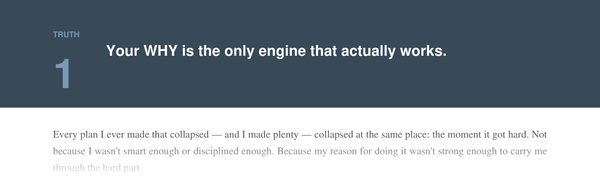
Every plan I ever made that collapsed — and I made plenty — collapsed at the same place: the moment it got hard. Not because I wasn't smart enough or disciplined enough. Because my reason for doing it wasn't strong enough to carry me through the hard part.
Right after high school, I passed the rigorous entry examination to a shipbuilding engineering program — a competitive program that most applicants did not survive on the first attempt. I did not survive it either, but not for lack of ability. I had enrolled with the primary goal of getting on a trip abroad — my one shot to see beyond the Iron Curtain. The real reason I was there was not engineering. It was escape. Two years in, with no trip materialising and no genuine purpose anchoring the effort, I was out. The dream didn't die. But I learned: a weak WHY produces a weak HOW.
When I finally left Poland for good — with $300, two suitcases, and my wife beside me — the WHY was years in the making. That's why it worked.
I left Poland in the summer. The Berlin Wall came down months later that same year. I was free — officially, legally, geographically. And yet, for years in Canada, I still flinched at authority. Still kept plans quiet. Still over-explained my movements to people who had no power over me whatsoever.
A Polish friend of mine — a good man, a hard worker — went white one afternoon at the factory when police motorcycles rolled past outside. They were dropping bikes off for a tune-up two doors down. He was calculating how to get out the back. The officers never came in. But years of conditioning had already written the story in his head before the bikes even stopped.
The physical border is one crossing. The mental border is a practice — and it takes considerably longer to cross.
Pages 1 to 3 of 9. Scroll down inside the window to read them.
Get the full guide free